How to Mount a Hose Reel to a Stucco House
Mount a hose reel to a stucco house by fixing the bracket through the stucco and into the wood framing, not into the stucco coat alone. Drill pilot holes, seal each one, drive the fasteners, then hang the reel and check that the bracket sits flush.
On this page (8 sections)
- How do you find the framing behind stucco?
- What anchors and fasteners work in stucco?
- How do you drill and seal the mounting holes?
- Where should the reel sit on the wall?
- How do you hang the reel and check it holds?
- Which reel suits a stucco wall?
- What goes wrong after mounting, and how do you fix it?
- Which mount is best for your stucco wall?
Mounting a hose reel to a stucco house means fixing the bracket through the stucco and into the wood framing, not into the stucco coat alone. A hose reel carries the full weight of a wet hose and takes a steady pull every time you wind it, so the fasteners need to reach something solid.
The stucco layer is only a thin outer shell over framing or masonry. Treat it as a surface to drill through and seal, not as the material that holds the reel.
That one idea shapes every step below, from where you place the bracket to which anchors you buy.
How do you find the framing behind stucco?
Find the framing with a stud finder set to deep-scan mode, or by tapping the wall and listening for a solid sound. Mark each stud line in pencil before you drill anything.
Stucco is usually 3/8 to 1 inch thick over sheathing and wood studs spaced 16 inches apart. A standard stud finder can struggle with that depth, so use one rated for deep scanning or slide it slowly across the wall and repeat the pass.
If the readings stay unclear, drill a small test hole where the bracket will cover it later. Check for wood chips on the bit.
A test hole inside the bracket footprint hides under the reel and gets sealed afterward.
Mark the bracket's mounting holes on the wall, then adjust the marks so each fastener lands on a stud. A reel that spans two studs spreads the load far better than one anchored between them.
Frame spacing matters more than wall height here. A bracket wide enough to catch two studs at 16 inches on center is stable even with a full hose on it, while a narrow bracket squeezed between studs leaves you relying on anchors alone.
What anchors and fasteners work in stucco?
Use fasteners long enough to pass through the stucco and bite well into the framing. Ribbed plastic anchors are the practical choice when the screw reaches wood or a solid core.
Lag screws or structural screws into studs are the strongest option. If the bracket holes don't line up with framing, ribbed anchors set into the stucco and sheathing can share the load, provided the screw still reaches solid material behind.
THE CIMPLE CO's ribbed plastic anchor kit is compatible with stucco, brick, concrete, drywall and similar materials. The ribbed shape grips better than a smooth anchor, and the kit pairs #10-12 x 1 inch anchors with #10 x 1-1/4 inch screw clips.
Skip the kit if you're mounting into exposed studs or a masonry wall where a masonry anchor or lag screw does the job. Match the anchor to what sits behind the stucco, not to the stucco itself.
Its 1-1/4 inch screws are short for deep fastening needs, so use longer screws or choose a different kit when the stucco is thick.
The screws in the kit are hex head, so a socket or nut driver seats them tighter than a screwdriver. Tight seating matters on stucco, where a screw that stops short leaves the anchor proud of the surface.
How do you drill and seal the mounting holes?
Drill through the stucco with a masonry bit at the bracket's hole size, then switch to a wood bit if the fastener goes into framing. Seal each hole before and after the fastener goes in.
Drill slowly and let the bit do the work. Pushing hard cracks the stucco around the hole and leaves a loose patch that won't hold an anchor.
Vacuum the dust out of each hole, then run a bead of exterior sealant around the hole edge. Push the anchor or screw in and add a second ring of sealant over the head once it's tight.
This sealing step matters more on stucco than on siding. Water that gets behind the coat can't drain away easily, and repeated wet-dry cycles loosen the stucco around the bracket.
Should you seal behind the bracket as well?
Run a bead of sealant along the top edge of the bracket once it's hung, where rain runs down and sits. The bracket back doesn't need a full coat, but a capped top edge keeps water from tracking down the screw holes.
Leave the bottom edge open so any moisture that does get in can escape rather than pool against the wall.
Where should the reel sit on the wall?
Set the reel at about waist height, roughly 3 to 4 feet off the ground, so the crank handle sits comfortably under your hand. Check that the hose still reaches the far end of the yard from that spot.
Keep the bracket clear of downspouts, windows and outdoor outlets. Leave enough room on the hose side for the leader hose to curve without kinking against the wall.
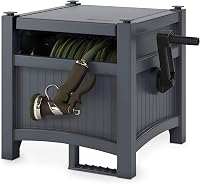
A wall-mounted reel saves space and keeps the hose off the ground. WERMAH's design puts the crank at a height where you don't have to bend or overreach, and its brass connector is angled to cut down on kinks.
Measure the wall space before you buy. The WERMAH frame is 17 x 15 x 17 inches, so leave clearance around it for the hose to wind and unwind freely.
Its 6.5 ft leader hose also sets how close the reel needs to sit to the spigot. Plan that span before you choose the spot, so the leader reaches without a strain on the fittings.
How do you hang the reel and check it holds?
Hang the empty reel on the bracket first, then load the hose and test the pull before you trust it. A reel that shifts under load needs a second fastener or a move to better framing.
With the reel in place, check that the bracket sits flush against the stucco with no gap at the top or bottom. A gap lets water in and lets the reel rock every time you crank.
Wind the hose on and give the crank a firm turn. Listen for creaks at the bracket and watch for movement at the screw heads.
Tighten anything that shifts, and add a fastener if the bracket still moves.
The crank should turn without binding. If it feels stiff, check the connection between the reel and the bracket before blaming the wall, since a reel hung off square will drag on one side.
If the mounting points land between studs and the reel feels loose, move it to a spot that spans two studs. For masonry and stone walls, our guide to how to mount a hose reel to brick covers the anchor choices that suit a solid wall.
Which reel suits a stucco wall?
Pick a reel whose bracket lines up with your stud spacing and whose weight the fasteners can carry. A lighter manual reel is easier to hang on a stucco wall than a large cart.
The Hubiiett reel is 304 stainless steel and comes with a 5/8 inch x 100 ft hose already fitted. Its aluminum hose guide moves the coil left and right as you crank, which keeps the winding even.
It weighs 13 kg, so check the bracket fasteners before you lift it into place. The rolled edge on the side disk and the brass connectors are built for outdoor use.
The guide sits under a fitted cover, which keeps grit out of the track on a windy wall. That matters on stucco, where a textured surface sheds dust onto whatever hangs below it.
If you want a reel you can move around the yard, a cart may suit you better than a fixed wall mount. Our guide to what is the best garden hose reel compares wall reels and carts side by side.
What goes wrong after mounting, and how do you fix it?
The most common problems after mounting are water getting behind the stucco and a bracket that works loose. Both show up within a season if the holes weren't sealed or the fasteners missed the framing.
Watch the wall around the bracket after heavy rain. A dark patch or bubbling paint means water is getting in, so pull the fastener, dry the hole, and reseal it.
A reel that wobbles under load usually has fasteners sitting in stucco alone. Move the bracket so its holes reach framing, or add a horizontal mounting board fixed to the studs and hang the reel from that.
Leaks at the reel itself are a separate job from the mounting. Our guide to how to fix a leaking hose reel covers the connectors and washers that cause drips.
A leaking connector that soaks the wall makes any stucco problem worse, so fix drips early.
If a crank feels stiff after the reel has been up a while, check that the reel still turns square on the bracket. A mount that has shifted slightly puts the drum at an angle and makes every turn harder.
Which mount is best for your stucco wall?
For most stucco houses, the best approach is a manual wall reel fixed through the stucco into two studs, sealed at every hole. That setup handles the weight and the crank pull without stressing the outer coat.
Check your stud spacing and wall height first. Then choose a reel whose bracket fits that span.
If you want a retractable model instead of a manual crank, our guide to the retractable hose reel wall mount covers what changes when you mount one.
Whichever reel you pick, the steps stay the same: find the framing, drill and seal, drive the fasteners into solid material, and test the load before the hose goes on. That is how to mount a hose reel to a stucco house so it stays put through wind, rain and a full hose.
Frequently asked questions
Can I mount a hose reel directly into stucco without finding a stud?
No. A hose reel pulls hard when you wind it, so the fasteners have to reach solid framing behind the stucco.
Anchors set only in the stucco coat will loosen or pull out under that load.
Do I need to seal the holes after mounting?
Yes. Fill each hole around the fastener with exterior sealant so rain can't get behind the stucco.
Water trapped in the wall causes more damage than the mounting job itself.
How high should a hose reel sit on a stucco wall?
Set the reel at about waist height, roughly 3 to 4 feet off the ground, so the crank handle falls comfortably under your hand. Check that the hose still reaches the far end of the yard from there.